




Digital X-rays
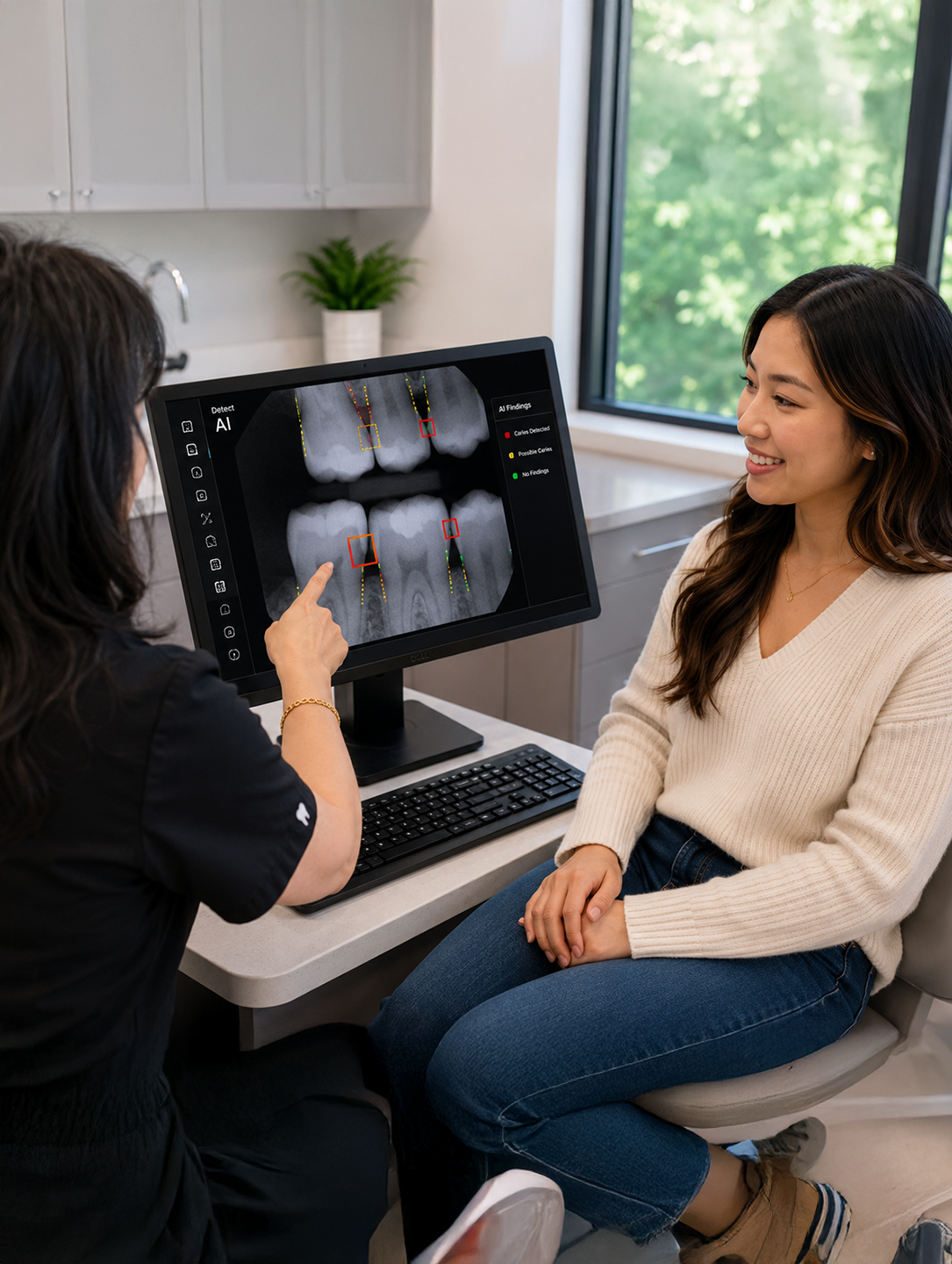
Digital X-rays are an advanced imaging technology used to capture detailed images of the teeth, gums, jawbone, and other oral structures. Unlike traditional X-rays that rely on film, digital X-rays use electronic sensors to capture images, which are then displayed on a computer screen in real time. At Infinite Smile Dental, our digital X-ray technology is enhanced with Artificial Intelligence (AI), which analyzes each X-ray to predict and highlight additional areas of concern that might not otherwise be detected by viewing the X-ray alone. This provides Dr. Kimberly G. Kau with additional information to help develop appropriate treatment plans and identify areas that may require treatment or monitoring over time.

Digital X-rays are divided into several types, each serving different diagnostic purposes:
- Intraoral X-Rays: These provide highly detailed images of individual teeth and surrounding structures, making them essential for diagnosing cavities, evaluating the health of tooth roots, and checking the status of bone density.
- Extraoral X-Rays: Extraoral X-rays capture broader views of the entire jaw, sinus area, and skull and are often used to evaluate jaw alignment, TMJ (temporomandibular joint) issues, and impacted teeth.
How Digital X-Rays in Pleasanton, CA, Work
Digital X-rays at Infinite Smile Dental Inc. use a small electronic sensor placed inside the mouth to capture images of the teeth and gums. These sensors transmit the image directly to a computer screen, allowing Dr. Kau to review high-resolution images instantly. Artificial Intelligence (AI) then analyzes the digital X-ray to predict and highlight additional areas of concern that may require further evaluation or monitoring, providing Dr. Kau with additional information to support diagnosis and treatment planning.
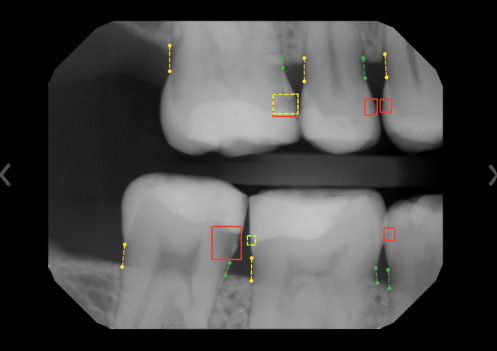
Example of AI-assisted analysis using color-coded overlays to predict and highlight areas of concern—including cavities, bone loss, calculus, restoration imperfections, and other findings—for Dr. Kau to evaluate as part of the diagnostic process.
The process involves the following steps:
- Positioning the Sensor: Dr. Kau or a dental hygienist places a sensor in your mouth, carefully positioning it to capture the needed images without causing discomfort.
- Image Capture: Once the sensor is in place, a low-dose radiation source captures an image of the designated area. The sensor immediately sends the image to a computer monitor, where Artificial Intelligence (AI) analyzes the digital X-ray to predict and highlight additional areas of concern for Dr. Kau to evaluate.
- Analysis: Dr. Kau reviews both the digital X-ray and the AI-assisted analysis image, using her clinical expertise to evaluate the highlighted areas and determine whether treatment or continued monitoring is appropriate.
- Discussion: You’ll have the opportunity to review the images alongside Dr. Kau. This real-time viewing allows for greater understanding and transparency, as she can point out areas of concern and discuss potential treatment options right away.
Digital X-rays also enable seamless storage and sharing, making it easier to maintain an accurate record of your oral health and share information with specialists when necessary.
Types of Digital X-Rays Used in Dentistry
At Infinite Smile Dental Inc., Dr. Kau employs a variety of digital X-rays to cover different diagnostic needs:
- Bitewing X-Rays: Used to detect decay between teeth and assess the integrity of fillings. These images help diagnose cavities that may be hidden and difficult to detect with a visual examination alone.
- Periapical X-Rays: Show the entire tooth, from the crown to the root. These are invaluable for detecting issues with the tooth root and surrounding bone, such as infections or cysts, and are often used in cases requiring root canal treatment.
- Panoramic X-Rays: Provide a broad view of the entire mouth, capturing the teeth, upper and lower jawbones, and sinuses. These are useful in evaluating jaw alignment, detecting impacted teeth, and identifying any structural abnormalities in the jaw.
- Cephalometric X-Rays: Generally used for orthodontic assessments, capturing the side profile of the head. They are helpful in planning orthodontic treatment and evaluating jaw alignment and growth patterns.
- CBCT (Cone Beam Computed Tomography): An advanced 3D imaging technology that provides a comprehensive view of your oral structures. Used mainly for implant planning, TMJ evaluation, and complex surgical cases, CBCT produces a 3D image of the mouth, helping Dr. Kau make more informed treatment decisions.
Advantages of Digital X-Rays Over Traditional X-Rays
Digital X-rays bring significant benefits, both in terms of patient safety and diagnostic accuracy:
- Reduced Radiation Exposure: Digital X-rays emit up to 80% less radiation than traditional film X-rays, providing a safer experience for patients. Although traditional X-rays are still considered safe, digital technology further minimizes exposure, especially for those who require frequent imaging.
- Faster and More Efficient: With digital X-rays, there’s no need to develop film, which means images are available instantly. This real-time viewing speeds up the diagnostic process and allows Dr. Kau to discuss your treatment options with you during the same appointment.
- Enhanced Image Quality: Digital X-rays provide high-resolution images that can be enhanced, zoomed in on, and adjusted for better visibility. This clarity helps Dr. Kau identify issues more accurately and diagnose conditions at an earlier stage, making treatment more effective.
- Environmentally Friendly: By eliminating the need for chemical film development, digital X-rays are more environmentally friendly, reducing waste and chemical exposure.
- Easy Storage and Accessibility: Digital images can be easily stored in a patient’s electronic dental record, making it simpler to track changes over time. They can also be securely shared with other healthcare providers, enhancing continuity of care. Contact us to learn more.
What Can Digital X-Rays Detect?
Digital X-rays, enhanced with Artificial Intelligence (AI), provide detailed insights into various aspects of dental health. At Infinite Smile Dental Inc., Dr. Kau uses digital X-rays and AI-assisted analysis to evaluate the following conditions:
- Tooth Decay: Detecting cavities early prevents decay from spreading, which would require more invasive treatments.
- Gum Disease: X-rays can reveal bone loss associated with gum disease, helping in early intervention to prevent further damage.
- Infections or Abscesses: Digital X-rays allow Dr. Kau to identify infections at the tooth root or within the jawbone.
- Oral Tumors and Cysts: Early detection of abnormal growths in the mouth or jaw can be life-saving.
- Bone Density and Health: Digital X-rays assess bone density and health, which areparticularly important for patients considering dental implants or suffering from periodontal disease.
How Often Should You Have Digital X-Rays in Pleasanton, CA?
The frequency of digital X-rays depends on your individual oral health needs. While some patients may only need X-rays every one to two years, others may require them more frequently due to specific dental conditions, risk factors, or ongoing treatment. The following are general guidelines:
- Routine Check-Ups: For patients with a healthy mouth and no history of dental issues, X-rays may be recommended every one to two years.
- High-Risk Patients: Patients with a history of cavities, gum disease, or other dental conditions may need X-rays more frequently, sometimes every six to 12 months.
- During Treatment: X-rays are often necessary before, during, and after treatments such as root canals, dental implants, or orthodontic procedures.
Dr. Kau will tailor the frequency of your X-rays to ensure optimal health and safety.
In Summary
Digital X-rays, enhanced with Artificial Intelligence (AI), play a vital role in modern dentistry, offering a safer, more efficient, and environmentally friendly way to evaluate and manage oral health. At Infinite Smile Dental Inc. in Pleasanton, CA, Dr. Kau and her team leverage this advanced technology to provide patients with top-quality, personalized dental care. By combining digital X-rays with AI-assisted analysis, Dr. Kau has additional information to help diagnose conditions, develop appropriate treatment plans, and identify areas that may require treatment or monitoring over time, ensuring each patient receives accurate, timely, and effective care.
Ready to get started? Schedule your appointment at our Pleasanton, CA, dental practice today and learn how we can help you achieve your oral health goals with personalized, high-quality dental care.
❤️ Restoring Confident Smiles, Infinitely.
👉 Ready to schedule? Book your appointment
online: infinitesmiledental.com/book-online/
📞 Contact us at (925) 400-9978 or DM us to
schedule your appointment.
📍 Conveniently located off I-680 at Stoneridge
Drive and Willow Road, Pleasanton, CA.